10

I enjoy eating ramen noodles cooked in the microwave at work. I've already learned to toss the sodium seasoning packet to avoid the salt, but I notice the noodles themselves have lots of fat and much of it saturated. (I understand the noodles are deep-fried as part of the preparation for packaging.) In an attempt to reduce the fat content, I dump the water after the noddles are cooked and add more water to start up a new broth.

(For reference, I add Thai red curry seasoning and either an egg, canned salmon or both. If I have one, I'll squeeze a lime over the finished product.)

Does it help reduce the fat content of the meal if I dump the initial broth? Is there any way to know how effective the practice is?

Jon Ericson
  • 556
  • 1
  • 4
  • 16

3 Answers3

11

Fat floats, so if you dump the water into a bowl and let it sit for a bit, you can see how much floats to the top. You can then remove the fat in any of the normal ways (this is exactly the process you use to defat a stock or a soup), and measure it.

Of course, I quickly looked up the nutrition information on ramen, and it has ~7g fat, ~3g saturated. An egg is ~6g fat, ~2g saturated. The fish is ~27g fat, ~6g saturated. Check your red curry seasoning as well (varies a lot by brand/type) So it seems like your approach is misguided, but nutrition questions are off-topic here.

edit: From thinking about your comment, you may want to try switching to spaghetti. You can just break it until it fits in the bowl, and it should be cookable in a bowl in the microwave, or even soaking in boiling water. You won't get perfect al dente or anything close, and my Italian ancestors will be after me for even suggesting this, but it will cut down on the fat. You can even get whole-wheat spaghetti.

derobert
  • 13,272
  • 5
  • 46
  • 69
11

I've done the experiment suggested by derobert:

  1. Added hot water to the ramen noodles in my microwaving container
  2. Microwaved for 2 minutes (I usually pour off the water and start over after one, but I wanted to give this the best chance that I'd get a result.)
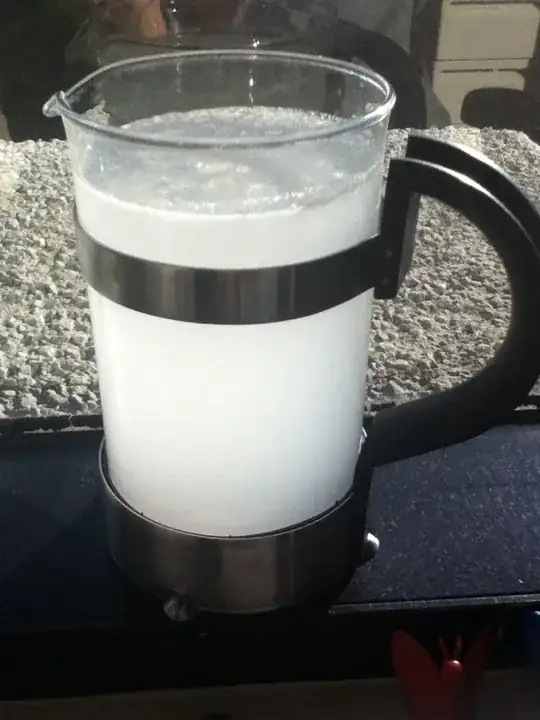
  3. Poured the water into a glass container (I used my french press, which looks a bit like a chemistry beaker.)
  4. Stirred the broth and allowed it to sit overnight

The photo I took this morning is not particularly appetizing:

Container of semi-transparent liquid with a bit of froth on top

You can't tell from the picture, but there is a layer of fat that may be skimmed off the surface. The cloudy water seems to be the result of other matter in suspension. It isn't fat, however. I don't have a scale so I don't know exactly how much fat I save. But my subjective opinion is that the practice is worthwhile.

The experiment also encourages me to shop around for alternate noodles such as those suggested in the comments to the question.

Carolus
  • 103
  • 3
Jon Ericson
  • 556
  • 1
  • 4
  • 16
1

I don't follow follow the directions but went to looking at ways to reduce the content just by adjusting cooking and rinsing procedures. Using one block of ramen in a medium sauce pan add water until the block is floating 2" from bottom of pan. Bring to a boil and allow to boil for 15 min or until the noodles are completely white. Remove from heat and place the pan in the sink. Using hot water, add water to the pot till overflowing and leave under tap until water in pot turns clear. Doing this should help to extract a fair average amount but it will result in a not so desirable texture of soggy noodles obviously. Healthier solutions should still be utilized as afforded.

An educated guess was arrived at collecting all rinse water in a large vessel and chilling it, then draining the solidified fats off the surface into a coffee filter. Filter was weighed dry before and weighed again after drying completely at room temperature. Filter measured 4.2 grams difference with surface fats and fine suspended solids. Pureeing the leftover noodles in hot water and following a similar procedure yielded only .5 grams difference in what remained.