Short answer: store mayonnaise has less yolks per volume oil, and yolks give most of the yellow color.
Mainly the reason is that store mayonnaise adds water, rather than relying on the moisture in the egg yolks and vinegar. To quote On Food and Cooking, page 634:
Though cookbooks often say that the
ratio of oil to egg yolk is critical,
that one can only emulsify a half-cup
or cup of oil, this isn't true. A
single yolk can emulsify a dozen cups
of oil or more. What is critical is
the ratio of oil to water: there must
be enough of the continuous phase for
the growing population of oil droplets
to fit into.
This means you can use less yolks and just add water to get your volume. Since yolks impart most of the yellow color (from plant pigments called xanthophylls), this reduces color considerably.
Store mayonnaise also uses some whole eggs, not just yolks, which do not emulsify as well, but are cheaper. This further reduces the amount of yolk in the result. Note that while home mayonnaises use yolks, store mayonnaises can get away with including egg whites by using very powerful machines to emulsify the mayonnaise, and in some cases add emulsifiers such as lecithin to help stabilize it.
The Experiment!
One whole, very jumbo egg, with a little white wine vinegar (around 15 mL). For oil, I used vegetable oil with a small splash of olive oil. The total amount of oil used was 1.5 cups, or 350 mL.
First, I tried to create mayonnaise by hand whipping with a mini-whisk. It turned out a pale yellow, and thickened some, but refused to thicken fully. This confirms that making a homemade mayonnaise by hand requires yolks or some sort of mechanical beating/blending; whole eggs just don't emulsify well enough. It's fair to say that the result is quite yellow when it isn't fully blended.
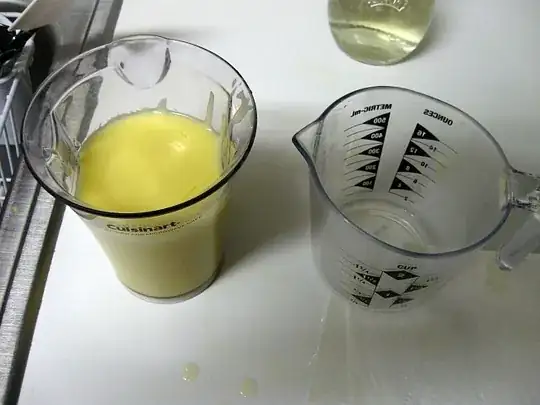
Next, I gave it a shot with my immersion blender:
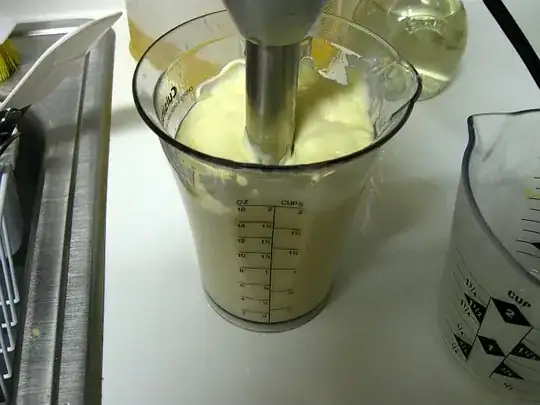
See how much lighter and paler the mayonnaise is! I can only speculate that the blender created a much finer emulsion, and incorporated more air, reducing the impact of the oil and yolk color on light scattered off the micro-droplets.
Finally, I went ahead and added flavorings (a little dijon mustard, a ton of paprika, salt, pepper, and more vinegar). In this comparison against commercial mayonnaise, you can see that the result is now darker and more orange, courtesy of the paprika. It is also clear how close the color was before adding paprika.
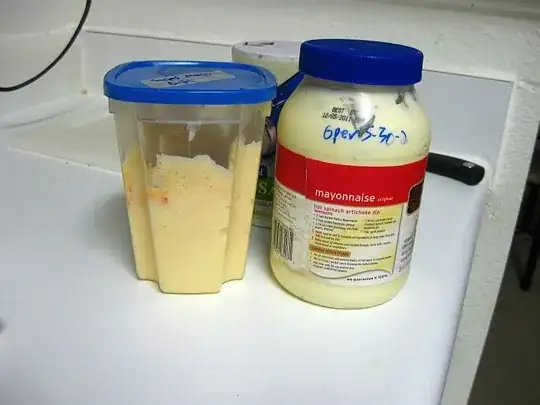
Clearly, the use of whole eggs is the biggest part of the equation. It is clear that by adding more water to thin the emulsion and then adding oil to achieve the proper consistency, I could make this even paler, very close to store mayonnaise. The use of mechanical blenders may assist in the process, producing a finer and paler emulsion.
Recipes that include paprika also yield a more yellow-orange result; I think it is for this reason that my commercial mayonnaise uses "paprika oleoresin" in place of ground paprika.
Finally, the use of more heavily colored olive oil appears to darken the resulting mayonnaise. Given how bland my mayonnaise was with only a touch of olive oil, I would encourage you to blend in water and additional oil, rather than avoiding the olive oil. Ideally, the water would be added about a tsp at a time, when the mayonnaise is still somewhat liquid.


