I've read the question on the ideal fridge temperature, but am asking a more involved question about a baseline temperature and temperature spikes. How will a few hours each day at 10 C effect the contents of the fridge? What about two smaller spikes to 7 C?
Background: I live in a small studio. The fridge makes noise. I'd like it to be quiet at night. If I can do so without frequent food spoilage, I'll get a timer and turn the fridge off from 2300 to 0800. If this is a bit too much time without cooling, I plan to turn it off while I fall asleep (2300 to 0200), turn it back on (0200 to 0400), and then have it be quiet in the mornings again (0400 to 0800).
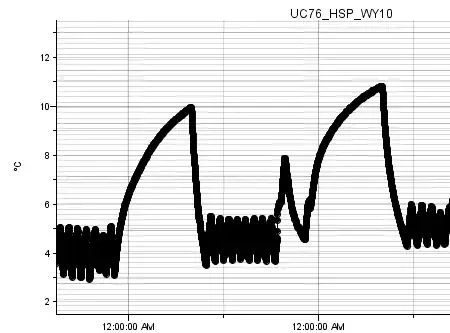
I've put some temperature loggers in the fridge and unplugged it manually during the 2300 to 0800 time. The graph is attached below. The mean temperature is 3 to 5 C, rising to 10 C.
The 2nd day was 'bad' data: I added a few gallons of water to increase the thermal capacity of the fridge (temp spike), but added them too late in the evening. The water did not cool to 4 C, and when I unplugged it the temperature shot back up. The first day, with an almost empty fridge, is a worst-case scenario. When the fridge is full I expect the max T at 0800 to be 8 or 9 C, not 10 C. I am collecting that data now and will update the post in a few days when I've checked the variability.
If 6-8 C for a few hours, then 8 to 10 C for a few more, then a quick return to 3 C is bad for the food (mostly OJ, soy milk, cheese, and some veggies), then I'll cool it in the middle of the night when I'm in a deep sleep.
So... to the question: How important is a 4 C fridge? Is a few hours per day up to 10 C bad? What about up to 7 C? Any other suggestions how to quiet the studio as I try to sleep?