6

There's a number of recipes I have that require (or at the very least benefit from) continuously stirring during extended periods (half-an-hour to one or a couple of hours). Having chronic neck/shoulder pain issues, that's a big problem for me.

So, I want to make a custom automated/motorized stirrer.

Options could include:

  • Wood (I have a good set of woodworking tools). Perhaps dark walnut, with walnut oil finish.
    • I know this is food-safe for things like cutting boards, salad bowls or spoons. Not sure what would happen with that material constantly dipped inside a simmering mixture (which could be significantly higher than 100 degrees Celsius).
    • I suppose I would need to avoid joining multiple pieces with glue (though ok for cutting boards, I doubt that it will be ok inside a simmering mixture)
  • Stainless steel — go to some metal shop that offer laser-cutting or whatever cutting process and cut a custom piece?
    • Is the stainless steel I would get there food-safe? (and what cutting processes would result in a food-safe piece?)
      • I tend to not trust any answers they could give me at a metal shop [*].
    • What about stainless steel screws/bolts/nuts/washers, the ones I get from a hardware store (say, to join multiple pieces into the complete assembly)? I do not believe there's much guarantee that those pieces are free from any other contaminating materials in addition to the stainless steel, but maybe that's my misunderstanding?
  • Perhaps there may be an easy way to entirely cover the assembly with a food-safe silicon sheet or piece?

Any comments?

[*] The irony is not lost on me, that I might be willing to trust a "yes, that is perfectly food-safe" answer from random strangers in an online forum! :‒)

Cal-linux
  • 163
  • 1
  • 5

5 Answers5

16

Apart from "stirring robots of various types are, in fact, a commercially available product" [which is the case, and there are versions aimed at home cooks (i.e. not all that expensive. Likely considerably less than "custom-making" one.)] There are some easy solutions.

Stainless steel hardware normally is made of alloys considered food-safe, typically 304 and 316. You'll want to wash it well, of course, to remove any machine oils from production/shipping/packaging. If your hardware store does not tell you what the alloy of their stainless hardware is, you can buy from somewhere else that does, such as McMaster-Carr (not associated, am an occasional and usually satisfied customer, nothing more.)

However, the simplest thing for the actual intentional food contact part of the robot is to use normal kitchen utensils, and simply set up the robot to hold those, and release them for washing without too much fuss. A silicone-headed spatula or scoopula or a wooden spoon are perfectly good options. Clamp the handle in the robot's motion mechanism and you have a normal food safe item in contact with the hot food.

"Incidental contact" food safe grease is available if there will be joints that need lubrication that are above the pot being stirred. You'll probably want to keep the motor somewhere that isn't over the pot itself; some commercial units do put it there, but presumably they have done whatever needs to doing to make sure their motor can take being exposed to hot steam in use, at least if they are a quality outfit.

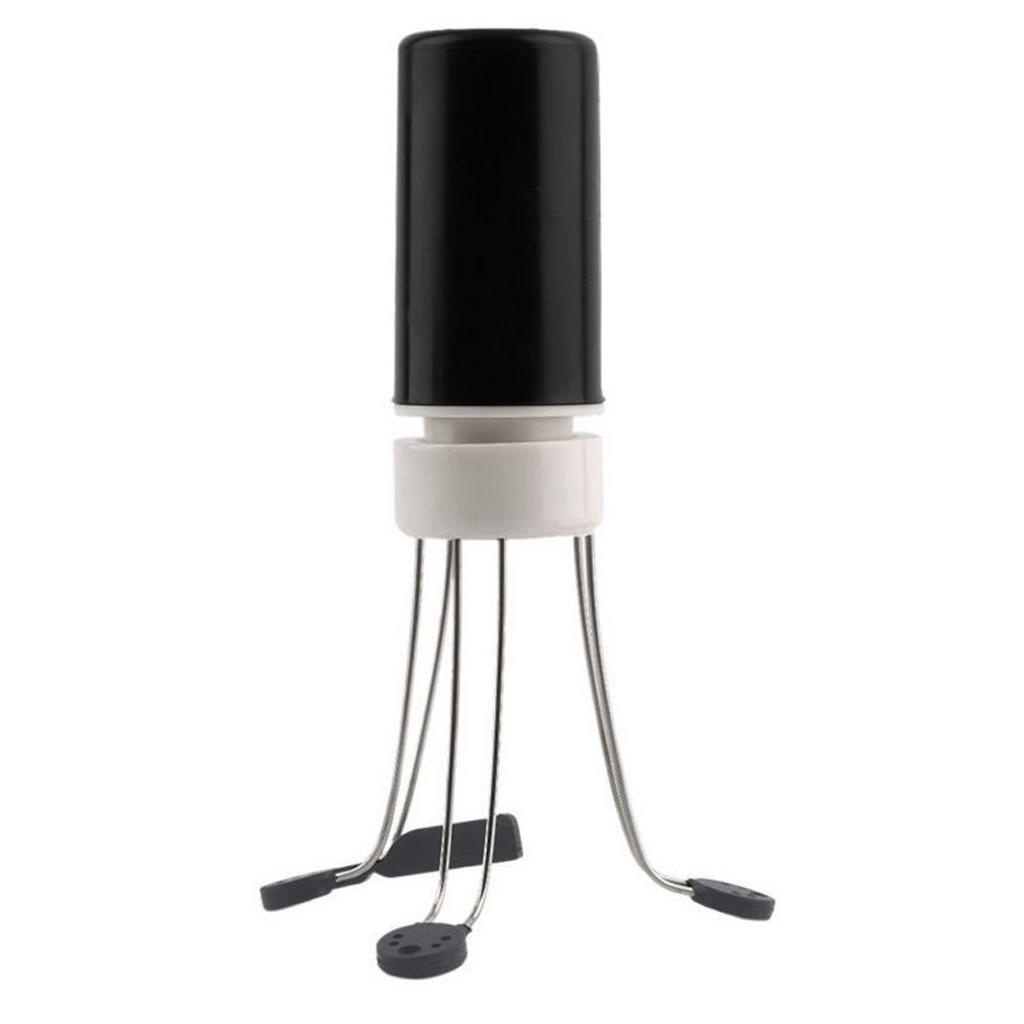
While the default approach is to mimic human stirring, there are other approaches. Several variants of this type of three-legged stainless and silicone thing are made, and they basically walk around the pot at random. Not what a human would do, but easy for an inexpensive robot.

Three-legged stirring robot

Image Source, no endorsement implied

Ecnerwal
  • 21,264
  • 35
  • 79
11

A third option is to get a portable magnetic stirrer/hotplate. These are used in laboratories world-wide for exactly this purpose. The heat control is generally excellent on them, and can even be precise enough that it will hold at a certain set temperature. They are generally used with glassware in a lab so I don't know how well this would work with your current pans, but stainless steels are non-magnetic I think.

The magnetic component consists of two parts, one below the heating element, which is a spinning head with a magnet in it. The second goes in your pot and is a encased magnet, that is placed into the liquid and rotates with the spinning head. Getting the right speed is a bit of an art, but a bit of practice makes it easily used. The encasing on the magnet is usually made to resist anything a lab can throw at it in terms of pH, temperature and reactivity, so should be fine in anything you will find in a kitchen.

bob1
  • 17,632
  • 33
  • 71
3

Trying to build everything from scratch seems quite complex. Of course, maybe you are one of the people who enjoys this, and in that case, go straight ahead.

But if you don't, consider using an existing mixer - either the classic horizontal shape with two stirrers, or those which look like a blender but can get a whisk attachment instead of a blender attachment. Then all you need to build is a frame which can hold the mixer suspended in the pot. It will have to be well-anchored, so the mixer will actually mix instead of starting to walk around like a washing machine does. But it should be doable, and much easier than creating your own motor and attachment. The only big downside is that it will stir in one spot only, because in that kind of rig, you have neither planetary motion nor an off-center attachment point, the way stand mixers do. Else, if you want low-effort, you can also buy a stand meant for lab equipment, and see how you can attach a kitchen mixer to it, at least the vertical, stick-blender-like kind. (Although at that point, you might just go with a commercial stirring device like the one from Ecnerwal's answer).

If you really want to make your own mixer, consider using standard mixer attachments and making the body yourself. They are already made in such a way as to fulfill your requirements - they have the proper shape and size, and can be attached and released to a body, are food-safe and dishwasher-safe. You may even be able to find a receptacle slot for them, or a whole gear set, sold as a replacement part for a big-brand mixer. Or go on a classified ad site and see if someone wants to get rid of a burned-out mixer that you can cannibalize for parts. These attachments do stir normally as opposed to scraping the bottom of the pot, but this will only be a problem for a few very specific use cases like a roux.

rumtscho
  • 141,844
  • 47
  • 316
  • 579
3

UHMWPE (Ultra high molecular weight polyethylene) is the (usually)) white material used in chopping boards and is stable and safe at under 100 C (and at quite a bit over that). It's one of the safest plastics available. If you trust the material in a chopping board (as maybe hundreds of millions of people do) then it's almost certainly suitable.

At high enough temperatures (well over 100 C) it softens excessively.

This datasheet should help:

  • Due to the minimal moisture absorption it is mainly used for applications in water. UHMW-PE – white is approved for the use of applications in contact with foodstuff.

  • Chemical resistance: Water up to 80°C.
    Boil a chopping board for a while :-) . It MAY soften slightly, but probably not.

See also here and here

In continuous operation at 100C it will soften, but not melt.


PTFE / Teflon is very safe at water temperatures.
Teflon is one of the most non-reactive materials available at the temperature of concern.
If heated too hot it can decompose and produce noxious gases BUT this does not happn until far far above boiling water temperatures. Teflon is expensive, but any itens coated in a very thin layer of Teflon would work very well safety wise.

Russell McMahon
  • 589
  • 2
  • 9
1

As long as we're adding all kinds of answer aside from a custom-made rig: if your recipes allow it, you can also go with a Thermomix, or any of the much more inexpensive generic clones. It will heat and mix your stuff in a single go, without you needing to babysit it after you've thrown your ingredients into it.

rumtscho
  • 141,844
  • 47
  • 316
  • 579