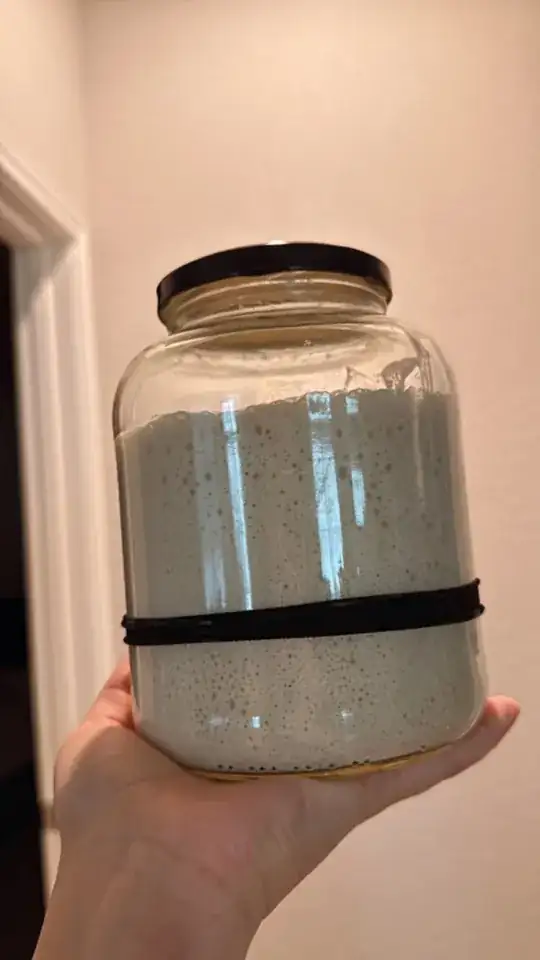
You asked "what is happening", so here we go:
I don't know how you started your sourdough, but I assume you made a mixture of water and flour and let that stand in a warm place for a few days.
During the initial mixing, in addition to flour and water, a great many microorganisms got into the dough as well - they float around in the air and everywhere around us.
These are lactic acid bacteria and yeast, mostly. They feed on the flour and reproduce; their metabolism creates CO2. This CO2 is what you see as bubbles in your dough.
Takeaway 1: when you see bubbles, you know that the microorganisms are alive.
The lactic acid bacteria taste/smell, well, sour (it's kind of in their name...). So, takeaway 2: if your sourdough smells and tastes sour, then it contains lactic acid bacteria for sure. As far as I understand, this acidity also is a factor in suppressing unwanted organisms (mold...).
Yeast is a wanted fungus; it forms a stable relationship in the mixture and provides mostly bubbles and of course a more or less intense yeasty taste.
Your sourdough will continue to rise until the microorganisms have metabolized all flour. Then it will stop, but everything will be just fine for some time. Eventually (after many hours or days) it will turn bad, because the lactic acid bacteria and yeast will eventually die off. At that time, other (unwanted) microorganisms will take over and eat them.
This is remedied by baking very often (unreasonable for home users) or putting it in the fridge. You don't need to freeze them even; the regular fridge temperature of 4-7°C is fine to keep it for months.
All the protocols for "refreshing" or "waking" your sourdough to get it ready for baking are not so much about the biology, but about making timing everything easier. If, before baking, you take a spoonful and mix it with fresh flour and water, you have a well-known "state", and with experience will eventually have a good feeling how long it takes until it is ready to continue baking. But in principle you could simply bake with the original starter, it will just be wildly inconsistent as to how long it takes.
You can keep it alive forever by taking off some amount whenever you bake - the only really critical point is that you must do that before adding salt, as the salt will basically kill the microorganisms or at least reduce them a lot.
If you keep the mixture in the fridge (not the freezer) for a very long time (many months) a clear fluid may appear on top; this smells bad but is harmless. You can simply decant it and continue as usual. Also eventually the top layer of the sourdough might become darker; this also doesn't matter really, it will only be a thin layer and you can scrap it off; below that the sourdough will be good.
Freezing is good to put away some backup in case a toddler grabs your glass from the fridge and destroys it, or you forget to take off some sourdough when baking. You can smear a thin layer of fresh sourdough onto baking paper, wait until it dries, then put it in a ziploc and freeze it. I have not experimented with that, but it should likely keep forever.
As Ecnerwals also mentioned, there are a great many opinions about sourdough out there. The fun part is - the microorganisms have not read any of those. They just do their thing happily, and don't care a bit about what someone on the internet has written. My own sourdough is about 15 years old, and that included times where I have not baked for a year straight, and when I eventually did, it was (after the usual refresher) just as always. It's all fine. Just don't let it stand in the warmth for days on end without feeding.