What can you replace eggs with in noodle/dumpling dough, that is dough for boiling? Without eggs, noodles have this glue-like glossy appearance and, in my view, inferior texture. As a big noodles fan (I mean home-made noodles, not store-bought pasta), I can say with confidence that the difference is clearly noticeable even when you make your dough with a 1:1 egg to water ratio. That tight springiness goes through the window. This question offered some general ideas about egg substitutes. I'm not sure anything fits, really. Laxseed mixed with water is expected to mix some seed bits in, compromising the smoothness. Apple sauce, banana are going to affect the taste. Commercial egg replacers are not easy to come by, I don't have a vegan shop nearby. Any suggestions?

4 Answers
Not all noodles or pasta has egg anyway.
You don't need to substitute, you can just leave them out. You can make them with just flour & water, or optionally add a little oil & salt. The longer you let the dough rest, the chewier the noodles will be. Some people add a little baking powder to soften them up.

- 29,950
- 5
- 75
- 116
What you want to achieve is replacing the protein mesh provided by egg albumin. You can mix extra wheat protein/gluten to the dry starch when making the dough if using wheat flour, in the form of vital wheat gluten. It's commonly added to low-starch/keto noodles for the desired springiness and resistance when not using wheat flour.
Amazon link to one variety of wheat gluten, in dry flour form.
Recipe for separating wheat flour into starch and gluten at home.
In commercial settings, wheat gluten protein is already added in a variety of noodle products to improve springiness and overall texture, especially for pre-cooked/frozen noodle products. At least for Asian-style noodles, an extra 3% gluten by flour weight produced the best texture:
Compared to FCNs [Frozen Cooked Noodles] with 1% and 5% gluten additions, recooked FCNs with 3% gluten addition had a similar texture property to control sample, and they had the highest tensile force and distance, and the lowest surface tackiness. Meanwhile, the recooked FCNs (3% gluten addition) had smaller pores, denser and more complex gluten network, and their force and elasticity during chewing were the best in sensory evaluation.
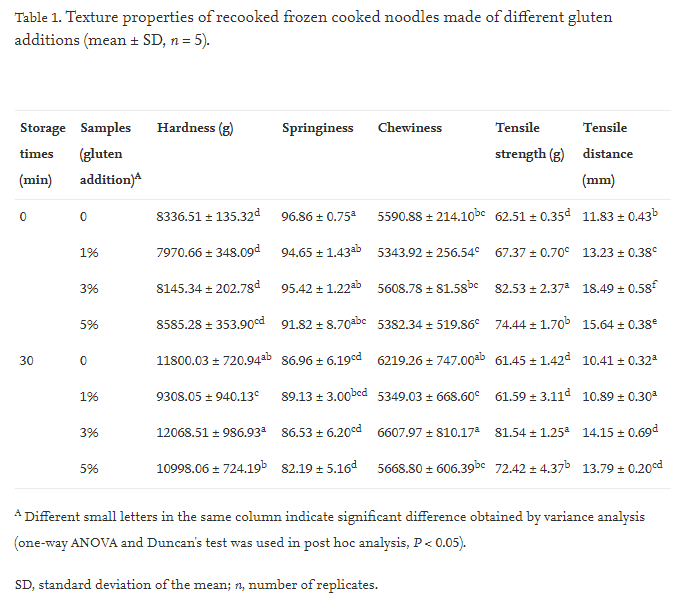
Noodle tensile force table from Wang et al. [1]
If adding wheat gluten is not an option for you and you are using wheat flour, you can try increasing the amount of gluten formed in your dough with the following:
- Use a higher protein content wheat flour. 'Hard' or 'bread' flour, or 00 fine grind semolina flour, are good options. Explanation of flour terms.
- Use an extended intense kneading process to help form and orient the gluten structure, similar to making udon noodles. @Unlisted was partially correct in his answer - udon achieves its characteristic chew and strength from a very well-formed gluten structure, though this requires a lot of physical input in addition to resting periods. This is not recommended for domestic mixers as the dough strength will be too much for most models to handle.
- The addition of baking powder suggested by @Unlisted is more along the lines of alkaline dough modification to improve gluten mesh formation - which can also be improved with a small amount of salt added in conjunction [2]. This has an effect on colour though, as wheat flour pigments turn yellow in more basic conditions.
[1] Effect of wheat gluten addition on the texture, surface tackiness, protein structure, and sensory properties of frozen cooked noodles.
Yuan-Hui Wang, Ya-Ru Zhang, Yue-Ying Yang, Jin-Qi Shen, Qiu-Mei Zhang, Guo-Zhi Zhang.
https://doi.org/10.1016/j.lwt.2022.113348
[2] The impact of salt and alkali on gluten polymerization and quality of fresh wheat noodles.
Ine Rombouts, Koen J.A. Jansens, Bert Lagrain, Jan A. Delcour, Ke-Xue Zhu.
https://doi.org/10.1016/j.jcs.2014.09.003

- 5,371
- 17
- 34
In Crossroads Cookbook, Tal Ronnen replaces eggs in Italian-style egg noodles with a combination of tofu (for protein and texture) and red palm oil (for color and fat), per this recipe. I have not tested it.

- 65,749
- 19
- 162
- 246
A common approach to replace the binding and thickening effects of eggs for many kinds of food (though I have never tried it for noodles) is (roasted) soybean flour. To get closer to the taste of eggs you might want to add a pinch of Kala Namak (Black Salt with a high sulfur content). You probably won´t find this ingredients in an average supermarket, but it should be possible to source them online.

- 2,119
- 8
- 17