20

The product of $2Z$ generally approximates the value of $m_\mathrm{a}$ of atoms that comprise relatively few protons. Whereas, the product of $2.5Z$ generally approximates the value of $m_\mathrm{a}$ of atoms that comprise relatively many protons. The product of $((2+2.5)/2)Z$ generally approximates the value of $m_\mathrm{a}$ of atoms that comprise a moderate number of protons.

What function from the $Z$ values produces a value that maximally approximates the $m_\mathrm{a}$ that corresponds to $Z$?

Geoff Hutchison
  • 27,740
  • 3
  • 79
  • 145
Hal
  • 2,315
  • 5
  • 22
  • 41
  • The stability of an atom depends on the number of protons and neutrons. Stability of the various isotopes, in turn, determines what we consider to be average atomic mass for that element. The relation is roughly linear but in truth complicated (which is how you get things like island of stability). – Superbest May 29 '15 at 23:38
  • @Superbest As Nicolau mentioned below, the empirical power law comes from the most stable ratio of neutrons to protons. And yes, this expression could fail at the island of stability. – Geoff Hutchison May 30 '15 at 00:31
  • I wonder if the answer is something like X^2/256 + 2*X + ? – R. Emery Sep 23 '16 at 20:16
  • As I mention below, I believe that the function that maximally approximates atomic mass from atomic number, using a single free parameter k, will be given by this equation (y being the atomic mass, and x being the atomic number). The variables can apparently be isolated to produce an exceedingly complex function which could in principle be fitted to the atomic mass data, though I do not have access to a program capable of doing so. If anyone wants to give it a shot, go for it. – Nicolau Saker Neto Jan 21 '17 at 00:21

2 Answers2

28

The short answer is that you can find a power-law fit ($1.61Z^{1.1}$) with low average error.

I'd never really thought about it much, but after downloading the IUPAC Atomic Weights, I decided to do some curve fitting.

Here's a linear fit between atomic number and atomic mass: linear fit of atomic mass from atomic number
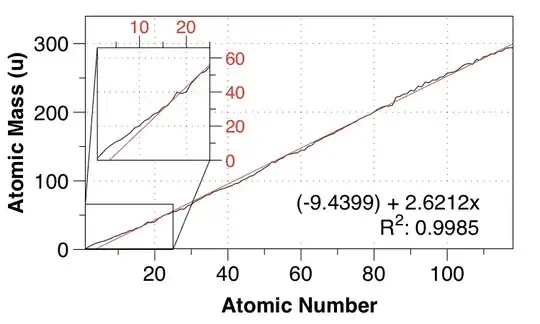
As you say, the fit isn't very good for small $Z$, but the overall fit isn't bad - the mean absolute error (MAE) is $2.821 \:\mathrm{u}$, and taken as a whole, the data is surprisingly linear. (Well, surprising to me.)

So I thought of a quadratic fit, requiring the intercept to be 0,0 to ensure the best fit for small $Z$:
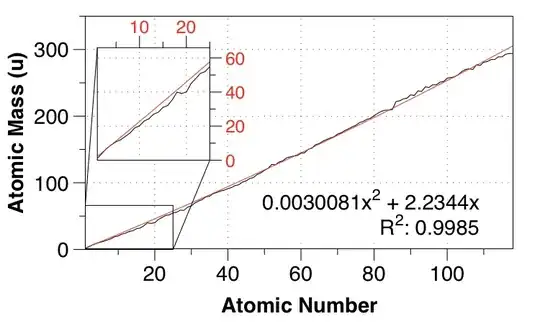
quadratic fit of atomic mass from atomic number

Looks better, right? Certainly the fit is much better for first and second row elements, but the MAE only reduces to $2.749 \:\mathrm{u}$.

So I went up to a cubic fit, again requiring 0,0 for the intercepts:
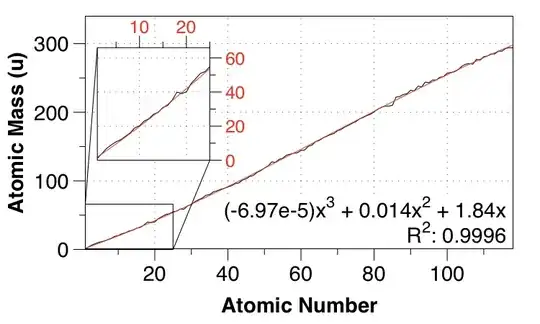
cubic fit of atomic mass from atomic number

Aha, now we're talking! We get the subtle nonlinearities, and the MAE is down to $1.36 \:\mathrm{u}$.

Thanks to the comment by Nicolau below, I performed a power-law fit.
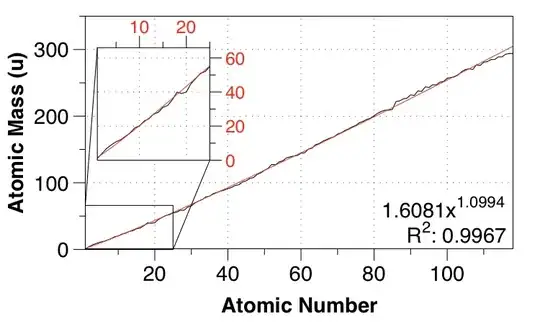
power-law fit

So that gives a power-law fit with MAE of $0.01 \:\mathrm{u}$ and a fairly easy-to remember function:

$m_a \approx 1.61Z^{1.1}$

Geoff Hutchison
  • 27,740
  • 3
  • 79
  • 145
-3

Atomic mass as a function of atomic number:

(Atomic number)^2/162 + 2*atomic number = atomic mass

It's the same as the answer given above except the final term is 2x

The equation for the first 16 elements is obviously just 2x.

X^2/162 is needed for the rest of the elements.

Thorium has 90 protons so 90^2/162+2*90 = 50+180=230.

The equation breaks down after thorium (140 neutrons)

After thorium 4 halo neutrons are added for every 3 protons.

https://upload.wikimedia.org/wikipedia/commons/d/d1/Uranium_atom.svg

R. Emery
  • 101
  • 2
  • 4
    please could you add a reference or explanation as to how this equation arises, e.g best linear fit to data etc. – porphyrin Sep 18 '16 at 09:45