23

Recently a post appeared on ChemSE asking why cyclohexane-1,3-dione (dihydroresorcinol) 1a doesn’t give a positive iodoform test. Unfortunately, the post was subsequently taken down after several comments. A paper by Fuson and Bull[1] reviewed the haloform reaction and stated that the iodoform test was negative for 1a. However, dihydroresorcinol undergoes the bromoform reaction[2] to yield both glutaric acid 9a and bromoform 7 as does 5,5-dimethylcyclohexane-1,3-dione (dimedone)[3] 1b yield β,β-dimethyl glutaric acid 9b and bromoform. Moreover, dimedone 1b affords the same diacid 9b and chloroform when sodium hypochlorite is employed.[4]

Mechanistically, dibromination of 1,3-diones 1 affords dibromides 2, non-enolic β-diketones. In alkaline medium diketones 2 cleave to provide dibromides 4 via intermediate 3. Further bromination of dibromides 4 sets the stage for the bromoform reaction on 5 leading to bromoform 7 and the glutaric acids 9.
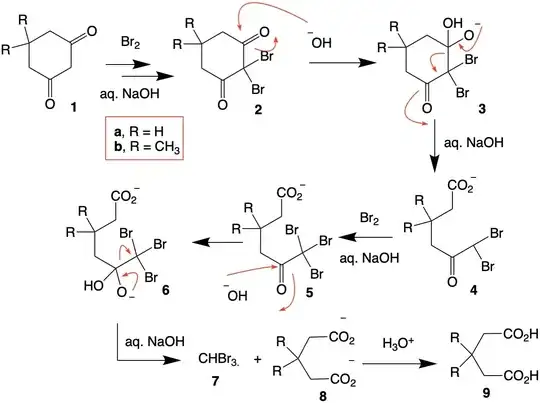


These reactions were found by searching Chem. Absts. but there was no sign of the iodoform reaction on these two diketones. So, the question is, why no iodoform reaction?

a) It is unimaginable that the reaction has never been conducted.
b) Perhaps more vigorous conditions are required.
c) The diiodo analog of dihalo diketone 2, if ever formed, may be formed reversibly by iodide or hydroxide reduction. Even so, the equilibrium should be shifted to the right.
d) If the diiodide is slow to fragment, might it undergo a Favorskii ring contraction instead?

Any insights are appreciated.

  1. R. C. Fuson and B. A. Bull, Chem. Rev., 1934, 15(3), 275-309. DOI: 10.1021/cr60052a001. PDF link
  2. D. Vorlander and M. Kohlmann, Chem. Ber., 1899, 32, 1878.
  3. G. Komppa, Chem. Ber., 1899, 32, 1423.
  4. W. S. Johnson and D. D. Cameron, Org. Syn., 1951, 31, 40. DOI:10.15227/orgsyn.031.0040
user55119
  • 16,609
  • 5
  • 56
  • 94
  • 6
    I wonder whether the di-iodo species forms under these conditions. This paper reports the selective mono-iodination of 1,3 dicarbonyl compounds including dimedone and claims no di-iodo products are formed. I would have expected to see some di-iodo product if di-iodination is possible https://www.researchgate.net/publication/228528584_Selective_and_effective_oxone-catalysed_a-iodination_of_ketones_and_1_3-dicarbonyl_compounds_in_the_solid_state – Waylander Jun 23 '20 at 06:57
  • 1
    @Waylander:I agree. I put my money on choice c). The diiodide never forms. If it did, cleavage is inevitable. – user55119 Jun 23 '20 at 10:50
  • Are the diiodides of 1,3-dicarbonyl compounds known compounds? – Waylander Jun 23 '20 at 11:44
  • 3
    @Waylander: They are known. HIO4/Al2O3 in dioxane forms diiodide of acetylacetone, AAE, diethyl malonate in high yield (Tet. Lett , 2006, 47, 3525). Conjugated alkynyl ketones with N-iodosuccinimide in aq. DMF (J. Org. Chem., 1998, 63, 4433). Some enterprising young chemist out there should prepare the diiodide by the first procedure and subject the product to the conditions of the iodoform rxn. The presence of iodoform will show that the diiodide is not prepared from the parent dione under haloform conditins. – user55119 Jun 23 '20 at 14:07
  • 2
    There's a Tet. Lett in that. If only we knew of an enterprising young chemist! – Waylander Jun 23 '20 at 14:16
  • @waylander: To be sure! – user55119 Jun 23 '20 at 14:28
  • As per what I have learnt, methyl ketones, I.e., CH3-CO- and groups containing CH3-CH(OH)- show positive iodoform test. You may want to refer to this site for detailed explanation and mechanism https://byjus.com/chemistry/iodoform-test/ So 1,3 cyclohexane-1,3-diones should not be able to give a positive iodoform test. Hope it helps. – PSR_123 May 27 '22 at 07:29
  • @Harikrishnan M: What is your concern? WIs it why the diiodo compound doesn't form? Other than that the second paragraph and the discussion between Waylander and me covers most of the issues and how to demonstrate that the diiodo doesn't form. Are you an "enterprising young chemist"? – user55119 Jan 02 '24 at 20:19
  • @Waylander: FYI...See the Comment above. – user55119 Jan 02 '24 at 20:20
  • There have been no answers to this question and this question was intriguing me hence the bounty. That is the point. – Harikrishnan M Jan 03 '24 at 09:07
  • Btw answers in comments may risk deletion by the roomba here. – Harikrishnan M Jan 03 '24 at 14:47

0 Answers0