1

When a heavy nucleus undergoes nuclear fission , it splits to two smaller, more stable nuclei and produces heat, similarly, when two light nuclei fuse, to make a heavier, more stable nucleus and produces energy.

The produced energy, is due to the mass defect between the reactants and the products, which is transformed to energy, according the mass-energy equivalence.

But if the products of each process(fission, and fusion) are more stable, that means that they have more binding energy, thus, shouldn't the mass defect be transformed to nucleus binding energy, rather than emitted as heat or another sort of energy ?

Positron12
  • 157
  • 1
  • 10

2 Answers2

3

Note that binding energy of nucleons does not mean contained energy, but the energy needed to break it.

Therefore kernels with lower binding energy per nucleon contain more nuclear energy per nucleon and have higher mass per nucleon.

It means forming kernels with higher binding energy per nucleon releases energy and vice versa.

It is the same as for chemical bonds, just some 6-7 orders higher.

E.g. nitroglycerine has lower binding energy per atom than reaction products formed by its explosion.

Poutnik
  • 41,273
  • 3
  • 49
  • 106
  • How does a lower binding energy mean a stronger nuclear force? it doesn’t make sense – Positron12 May 12 '19 at 16:12
  • It does not. It means higher energy, but weaker nuclear force binding them together. Similarly, nitroglycerine had higher energy and weaker chemical bonds – Poutnik May 12 '19 at 16:17
  • How does this answer my question? From where does the energy produced come from? – Positron12 May 12 '19 at 16:19
  • the energy come the same way as the energy of chemical reactions. Just the force is not electromagnetic force, but nuclear force. – Poutnik May 12 '19 at 16:32
  • Then why its calculated by the mass defect of the reaction, where did this lost mass go, if to the produced energy, then how did the products have a larger binding energy? I was taught that the binding energy is a result of a mass defect in the nucleus. – Positron12 May 12 '19 at 16:54
  • Again, it is the same as for chemical reactions. The mass and energy of free electron and proton are bigger than the mass and energy of proton-electron pair, bound in a hydrogen atom. The same for hydrogen atoms versus hydrogen molecules. The same for hydrogen/oxygen molecules versus water molecules. – Poutnik May 12 '19 at 17:07
  • So the energy released by the reaction is the energy that is released when forming the stable nuclei (binding energy) which is also equivalent to the mass defect? – Positron12 May 12 '19 at 17:28
  • Yes, with objection that the term mass defect is misleading. There is no physical defect. Mass is determined by the internal energy of the object. – Poutnik May 12 '19 at 17:41
1

When a heavy nucleus undergoes nuclear fission , it splits to two smaller, more stable nuclei and produces heat, similarly, when two light nuclei fuse, to make a heavier, more stable nucleus and produces energy.

That is correct. But note that there is a distinction between "light nuclei" and "heavy nuclei."

In other words "light nuclei" are light because when they fuse they release energy. But this doesn't say that you can keep fusing the "light products" ad infinitum and that you will keep getting another "light" nucleus. (Think about two mass 4 atoms fusing to make a mass 8 nucleus. Then two mass 8 atoms fusing to make a mass 16 nucleus, and so on....)

And "heavy nuclei" are heavy because when they fuse they release energy. But this doesn't say that you can keep splitting the "less heavy products" ad infinitum and that you will keep getting another "heavy" nucleus. (Think about a mass 256 atoms splitting to make two mass 128 nucleus. Then a mass 128 atoms splitting to make two mass 64 nucleus, and so on....)

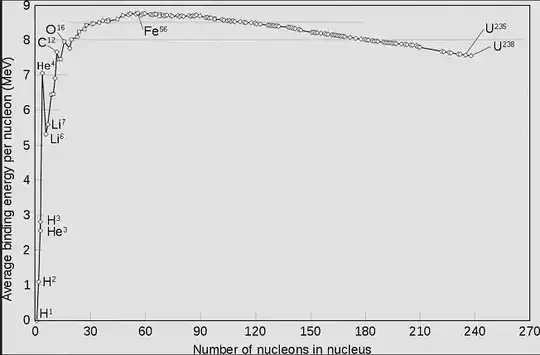
The nuclear binding energy curve is shown below.
enter image description here

So in a star fusing light elements to form heavier isotopes releases energy until $\ce{^{56}Fe}$. To make heavier elements requires energy. Thus elements heavier than $\ce{^{56}Fe}$ are not made by stellar fusion, but from super nova explosions and the collision of neutron starts.

MaxW
  • 22,242
  • 2
  • 36
  • 80
  • But this, doesn’t answer my question, I ask about the origin of the energy that is produced by the reaction. – Positron12 May 12 '19 at 16:14
  • 1
    The origin of the energy is Einstein's famous equation $E = mc^2$. So $\ce{^{56}Fe}$ has 26 proton and 30 neutrons. However its mass is less than the rest mass of those nucleons. If you fuse two atoms of $\ce{^{56}Fe}$ you get $\ce{^{112}Te}$. However one atom of $\ce{^{112}Te}$ is more massive than two atoms of $\ce{^{56}Fe}$. Conversely you can split one atom of $\ce{^{56}Fe}$ into two atoms of $\ce{^{28}P}$ which weigh more than the $\ce{^{56}Fe}$ atom. So fusing the two $\ce{^{28}P}$ atoms releases energy. – MaxW May 13 '19 at 17:57