I would suggest reading survival guides (or anything that will prepare you and give you an advantage) since academia is a difficult road. I would not worry so much about finding gender specific or field specific reading, especially if you are a male. The reason I say this is, while I am sure there are some factors that make males less likely than females to succeed in academia and some of these factors may be unique to "female dominated" fields, by limiting yourself to those factors, you are missing the critical fact that the vast majority of people fail to succeed in academia, regardless of gender or field.
For the purposes of this answer, I am going to define succeeding in academia as becoming a full professor. This is not demean those who choose to aspire to different goals (e.g., making a valuable contribution, having a well balanced life, or being happy), but it is merely a byproduct of the available data. For the same reason of the availability of data, I am also going to limit the analysis to STEM fields, for which Psychology is a member, but Education is not.
The reason I suggest reading survival guides is that over 99% of people fail (i.e., do not become a full professor) in academia regardless of gender or field. The Royal Society did a study which found that less than 0.5% of the people who enter academia do not succeed:
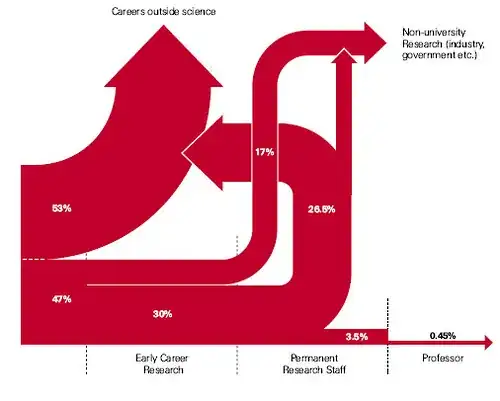
This is a huge problem, and if you are not prepared, and even if you are, you are likely to fail.
There is also a lot of research on gender differences. HESA has a study, which I can only find summary data of, which shows a "leaky pipeline" for women in STEM fields. For example, in the male dominated field of Physics:

at the GCSE level there are essentially equal numbers of men and women, but less than 6% of women are Professors. The same leaky pipeline exists in the so called female dominated field of Psychology:

At the undergraduate stage, the numbers are essentially the opposite of Physics with more women than men, but by the time you get to level of full Professor, the female domination is lost. The existence of this leaky pipeline means a lot of effort has gone into determining why women do not "succeed" in academia. The fact that both male and female dominate fields show the same trends means that most of the research into gender issues, in particular why women are less likely to succeed, are field (at least within STEM) independent.
In summary, men are doing better than women in "female dominated" fields, but no one is doing particularly well. Therefore, limiting yourself to small effects, while ignoring huge effects, is generally not efficient and you should read in a field and gender invariant manner.


