2

I really don't get how the chemistry works.

Like, I understand that the "baking soda"
(I'm not sure the term "sodium bicarbonate" is actually technically correct, so I'll just use the common term)
[EDIT: this was my first point of confusion]
has water molecules chemically bound inside its crystal structure,
[no]
and that heating it breaks those off and converts it to the anhydrous form, "washing soda"
[no]
("sodium carbonate" apparently?)
which is about 10-times stronger of a base.
(eg of claim (ie "10-times stronger"): youtube Adam Ragusea's "Ramen orecchiette — easy homemade alkaline noodle soup")

The problem is, when I go to make a noodle dough with dry "washing soda",
I find I need to add it to water and heat it first to really get it to dissolve,
which complicates the process of making a dough
(especially if you're using eggs, so you need to be careful to get it cool again before you mix those in).

So I was wondering if I could just pre-dissolve the "washing soda", and just use like a spoonfull of that in each batch of dough, except...

How does that not just convert it back into weaker "baking soda"?


EDIT:
Okay, so what thought I read about "sodium bicarbonate" being a technically incorrect misname was just completely wrong

https://en.wikipedia.org/wiki/Sodium_bicarbonate#Thermal_decomposition

That is, the thermal decomposition actually is changing the molecule itself,
and not just converting the crystal structure to the anhydrous form?

https://en.wikipedia.org/wiki/Sodium_carbonate

EDIT EDIT:
I have no idea what I was thinking, where the heck I thought I read that.
maybe I was vaguely remembering that "sodium bicarbonate" (NaHCO3) doesn't actually have double the CO3, but rather, "sodium carbonate" (Na2CO3) has double the Na relative to "sodium bicarbonate"?
And I somehow got that confused into... the thing about "water of hydration/crystallization"??


Or maybe I should just find some jiǎnshuǐ(碱水 (鹼水)) / kansui(かん水) or something, i dunno...?
[which is I believe something like 80% potassium carbonate and 20% sodium carbonate dissolved in water (not sure what concentration)]

dwawlyn
  • 55
  • 5

2 Answers2

3

Here's a bit of experimental proof that you can convert NaHCo₃ (baking soda/sodium bicarbonate/sodium hydrogen carbonate) to Na₂Co₃ (washing soda/sodium carbonate). It also indicates that it doesn't convert back in solution, exactly as we would expect.

Last night I put some baking soda in the oven for about an hour as it preheated to make pizza (up to 240°C). I then made a saturated solution of the resulting sodium carbonate , and another of baking soda, by dissolving an excess in hot water an allowing it to cool.

This is where I made a slight mistake. Baking soda starts to undergo thermal decomposition to washing soda at (per Wikipedia) 50°C. The water I used was probably about 80°C, and the baking soda fizzed, indicating thermal decomposition.

Despite that, I still saw a difference in the solubility (qualitative, not measured, as I was aiming for saturated solutions of both). Baking soda dissolved readily leaving a small amount of residue. Sodium carbonate left more residue, forming clumps, and less dissolved in total.

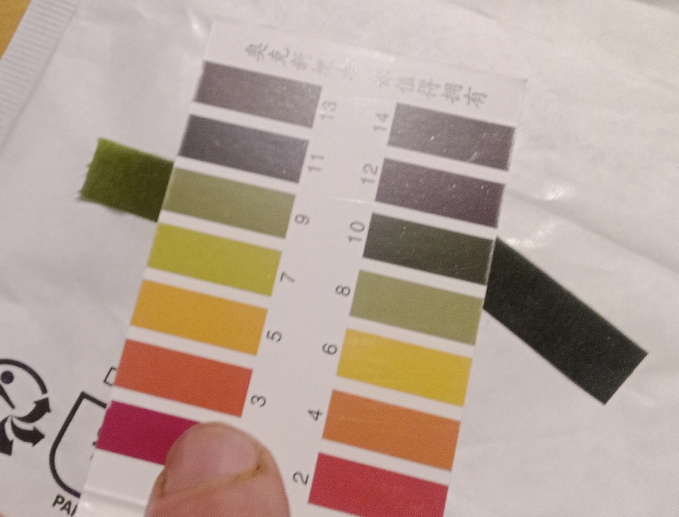
The more interesting difference is in the pH. universal indicator papers with sodium bicarbonate and sodium carbonate solution applied

On the left, pH about 9, we have the bicarbonate (with some contamination from the carbonate as my water was too hot) and on the right, pH about 10, the carbonate solution.

Notes:

  • When looking at tables of solubility, we need to consider the hydration state of the carbonate in particular - washing soda is the decahydrate, while straight out of the oven having been made from bicarb, it's presumably anhydrous. This will affect how much we can dissolve in a given quantity of water.
  • pH papers are cheap - I paid £2.99 (call it $/€4) for 160 strips on eBay, and you can use half strips. That's a lifetime's supply for the curious.
Chris H
  • 46,065
  • 2
  • 97
  • 164
1

Sort of to the title. The chemistry is quite incorrect though. Washing soda stays as washing soda in water, but you can't convert baking soda (bicarbonate) into washing soda (carbonate) or vice versa easily.

Sodium carbonate (Na2CO3) and sodium bicarbonate (NaHCO3) are not hydrated/dehydrated forms of one-another. Both are crystalline substances, the carbonate one of which can contain a water of hydration/crystallization. Washing soda itself is the decahydrate (10 water molecules per molecule of carbonate) of sodium carbonate and is written as Na2CO3.10H2O. This water is incorporated into the crystal structure. Bicarbonate slowly decomposes in the presence of water to release carbon dioxide, so crystals only occur in the anhydrous form (IIRC; chemists feel free to correct me).

There are several other hydrated crystalline forms of sodium carbonate, as well as the dehydrated (anhydrous) form. You can convert the hydrated forms into the anhydrous form by heating (I think; certainly into the monohydrate), but this doesn't change the chemical properties of the carbonate.

You can convert bicarbonate into the carbonate by heating in a process called calcination, but this involves restricting the supply of oxygen, which you can't easily do at home without some specialist equipment.

bob1
  • 17,632
  • 33
  • 71