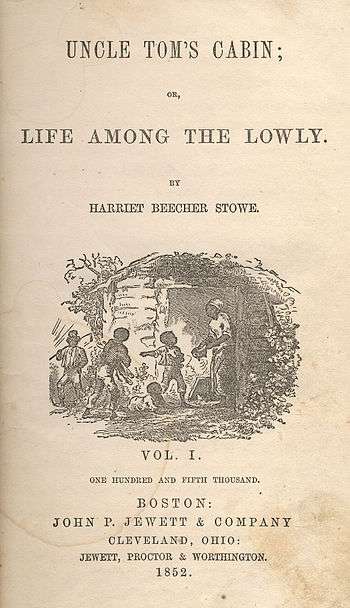
Uncle Tom's Cabin; or, Life Among the Lowly is a classic anti-slavery work written by abolitionist Harriet Beecher Stowe in 1853, a few years before the American Civil War.
In the beginning, Uncle Tom, Eliza, her husband George (belonging to another owner, but allowed to have a family), and her son Harry are all living relatively happily in a cabin behind a house in Kentucky. They have a good and kind master, Mr. Arthur Shelby. George is even earning money at another establishment.
Then Mr. Shelby gets into debt gambling, and he has to split up the establishment to pay the bills. Uncle Tom is sold to a slave trader who will then sell him "down the river[1]," and goes along with it because if he were to run, he'd just leave many of the other slaves to be sold instead. Harry is also considered for sale as a young and beautiful boy; rather than let literally unspeakable things happen to her child, Eliza scoops him up and makes a run for freedom, going so far as to cross the Ohio river from ice floe to ice floe. This dissuades her pursuers, since they think No One Could Survive That. George eventually follows her, escaping from his own owner who treats him real bad, and years ago separated him from his older sister Emily. Unfortunately, this is after the Dred Scott decision, so they have to run for the northern border and find each other...
Tom is bought by Augustine St. Claire after Tom befriends and rescues his Ill Girl daughter Evangeline. Tom and Eva combined eventually straighten Augustine out -- he was good for a New Orleans native, but he was also a fatalistic atheist. All of them combined help his sister Ophelia, a New Englander who hates slavery but didn't think of slaves as people until Augustine gave her one.
Augustine resolves to set Tom free in the aftermath of Eva's death. Unfortunately, his evil wife refuses to be made aware of this after ; she sells all the slaves that aren't her own property. (Yes, there were debts.) Tom ends up in the hands of the vicious sadist Simon Legree, who soon becomes determined to break Tom's Christian spirit or kill him in the attempt.
Stowe wrote this novel as an indictment of slavery. She uses Sarcasm Mode heavily, reminding readers that Tom, George, and Eliza are property, that attempts to help George and Eliza are illegal, etc. It is well-written and incisive, but the relative idyllism of the first couple of chapters, and her using self-sacrificing Tom as an example (he will do what his masters ask unless it is against his faith), have led to sharp Values Dissonance since. (There was some at the time, too, but of a different variety.)
The novel has been filmed dozens of times, both live-action and animated; The Other Wiki has a list. The 1914 version was added to the National Film Registry in 2012.
- Action Survivor: Eliza and her husband George.
- Author Tract: The novel is an antislavery polemic aimed at female readers, who were considered the guardians of Christian morality at the time. The narrator will frequently talk directly to the reader about how she should feel about what is going on, and ultimately ends up begging the reader to influence her husband into supporting abolition. The book is also very much in favor of supporting Liberia, which didn't turn out so well.
- Badass Preachers: The Quakers that help Eliza, George and little Harry to run away. .
- Brainless Beauty: Mary St. Clare.
- Breakout Character: Mr. Haley.
- Break the Cutie: Eliza, Uncle Tom, Emmeline.
- Broken Bird: Cassie.
- Dastardly Whiplash: Simon Legree is the Trope Maker, although he's more shaded in the book than any of the whiplashes inspired by him.
- Deadpan Snarker: Augustine and Miss Ophelia.
- Dead Little Sister: George has a missing older sister, Emily, who was sold many years before the story happens. .
- Defrosting Ice Queen: Miss Ophelia, Cassie.
- Heel Face Turn:.
- Heroic BSOD: Tom, during his first days in Legree's plantation. .
- Heroic Sacrifice: .
- Good Scars, Evil Scars: George Harris's slavery mark on his hand.
- Ignored Epiphany: Legree has a brief moment of surprise that Tom is still claiming to forgive him even as . There's a hint that he might change his mind, but the moment passes and Legree resumes his vicious cruelty.
- Ill Girl: Evangeline, who has tuberculosis.
- Magical Negro: Tom, especially at the St. Clare home.
- Manly Tears: "George Shelby wept tears that honored his manly heart..."
- The Messiah: Uncle Tom and Evangeline.
- Naive Everygirl: Poor, poor Emmeline.
- The Ojou: Evangeline, Miss Ophelia, Mrs. Alice Shelby, Mrs. Bird.
- Punch Clock Villain: Most of the slave traders, auctioneers, and owners. Owning and selling slaves is simply part of their jobs; their aim is to earn money, and they'll be kind or cruel depending on what gives them the most profit. They're villains not primarily because of how they treat the slaves, but because they simply don't think the slaves are fully human beings. Their cruelty is just a matter of efficiency and profit.
- Redemption Equals Death: .
- Royal Brat: St. Clare's nephew Alfred, though he gets better after Eva gives him a What the Hell, Hero?.
- Rich Bitch: Mary St. Clare.
- Sweet Polly Oliver: .
- Talk to the Fist: Simon Legree presses George Shelby's Berserk Button by mocking Shelby for "all this fuss, about" .
- Team Dad: Tom takes up this role pretty much towards everyone in the places he works at. Yes, even at Legree's horrible manse, where he helps the other slaves and they call him "Father Tom".
- Team Mom: Tom's wife Chloe.
- Arguably, also Miss Ophelia. Eva tries to be this, though she's obviously too young and sickly for it.
- Tender Tears: Tom cries often, and so does George Shelby.
- Token Good Teammate: Though the story is about the evils of the slave trade, and it's heavily implied the more evil masters are more typical, Messrs. Shelby and St. Clare aren't so bad, as far as slave owners go.
- Tomboy and Girly Girl: Topsy and Eva.
- Too Good for This Sinful Earth Tom and little Evangeline.
- The White Prince: George and Alfred. St. Clare is a more cynical version.
- ↑ slang for being sold to masters further in the South, where conditions were generally harsher